VLC in 6G Networks: From Laboratory Innovation to Real-World Infrastructure
Published:
As we move closer to the 6G era (expected around 2030), Visible Light Communication (VLC) is evolving from a promising laboratory technology into a core component of next-generation wireless infrastructure. In this post, I share my perspective on where VLC fits in the 6G puzzle — and why hybrid VLC/RF systems are the key to unlocking its potential.
The Spectrum Crunch Demands New Solutions
The demand for wireless data continues to grow exponentially. By 2030, estimates suggest global mobile traffic will exceed 5,000 exabytes per month — a 10x increase from 2025 levels. Traditional RF spectrum, even with mmWave and sub-THz bands, cannot shoulder this burden alone. This is where the optical spectrum enters the picture.
VLC operates in the 380–780 nm wavelength range, offering:
- Unlicensed bandwidth in the terahertz scale
- Inherent security — light cannot penetrate walls
- No electromagnetic interference — ideal for hospitals, aircraft, and industrial environments
- Dual-purpose infrastructure — LEDs provide both illumination and communication
My Research Journey: From IMS to AGRIFARM
My Ph.D. work at the University of Palermo focused on building an Intelligent Management System (IMS) for hybrid VLC/RF networks. The core challenge was seamless vertical handover — ensuring devices switch between light-based and radio-based connections without dropping packets or degrading quality of service.
Key findings from our research:
- Reinforcement learning outperforms traditional threshold-based handover algorithms by 35–40% in dynamic indoor environments
- Context-aware decision making (user mobility patterns, lighting conditions, RF congestion) is essential for practical deployment
- Hybrid architectures consistently outperform VLC-only or RF-only configurations in terms of throughput and reliability
These principles now inform my work on AGRIFARM-AI, where hybrid VLC/RF networks provide the communication backbone for IoT sensors in smart greenhouses. The unique advantage: LED grow lights double as data links.
6G VLC Integration: Current Trends
1. Integrated Sensing and Communication (ISAC)
6G envisions systems where communication and sensing merge. VLC naturally supports this — photodetectors can simultaneously decode data and sense environmental parameters like occupancy, gesture recognition, and indoor positioning.
2. AI-Native Network Management
Unlike 5G’s “bolted-on” AI optimization, 6G proposes AI-native architectures where machine learning is embedded at every layer. For VLC/RF hybrid networks, this means:
- Autonomous handover decisions using deep reinforcement learning
- Predictive resource allocation based on user behavior patterns
- Self-healing networks that adapt to lighting changes and obstructions
3. Quantum-Safe Optical Links
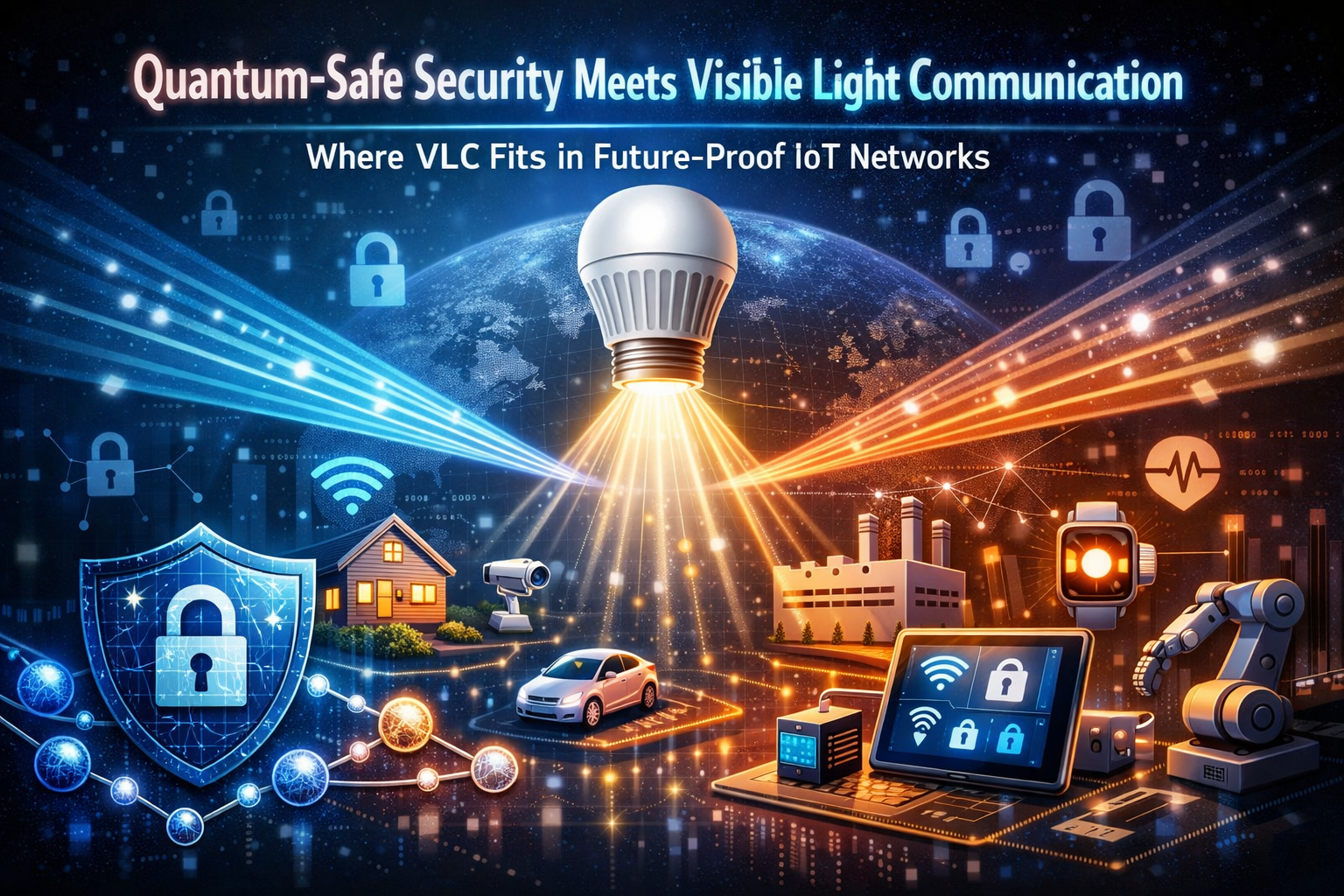
Quantum Key Distribution (QKD) through optical channels provides information-theoretically secure communication. VLC systems can be extended to support QKD protocols, offering quantum-safe data transmission alongside classical high-speed communication. This is an exciting intersection of my VLC and quantum communications research.
Challenges Remaining
Despite the momentum, several hurdles persist:
| Challenge | Current State | 6G Target |
|---|---|---|
| Data Rate | 10 Gbps (lab) | 100+ Gbps |
| Mobility | Walking speed | Vehicular |
| Coverage | Single room | Multi-room seamless |
| Standardization | IEEE 802.15.7r1 | Full 6G integration |
The standardization gap is perhaps the most critical. While IEEE and ITU are working on optical wireless standards, full integration into the 6G framework (under IMT-2030) requires coordination across traditional telecom, lighting, and semiconductor industries.
Looking Ahead
The VLC field is at an inflection point. The technology works. The economics make sense (LEDs are already everywhere). The spectrum is free. What’s needed now is:
- Robust hybrid management systems that make VLC invisible to end users
- Industry standards that allow interoperability between VLC and 5G/6G equipment
- Killer applications like indoor positioning, smart factory automation, and quantum-secured IoT that justify deployment investment
As someone who has spent the last 6+ years at this intersection of light and wireless, I’m optimistic. The 6G vision isn’t just about faster speeds — it’s about integrating every available spectrum resource into a cohesive, intelligent network. VLC is ready for its moment.
If you’re working on VLC, hybrid networks, or 6G research and want to collaborate, feel free to reach out.