The Open-Source AI Renaissance: Rivaling Proprietary Giants
Published:
The narrative that “proprietary is better” in Artificial Intelligence is officially dead. By early 2026, the gap between closed-source giants and the open-source community has not just narrowed—it has effectively closed.
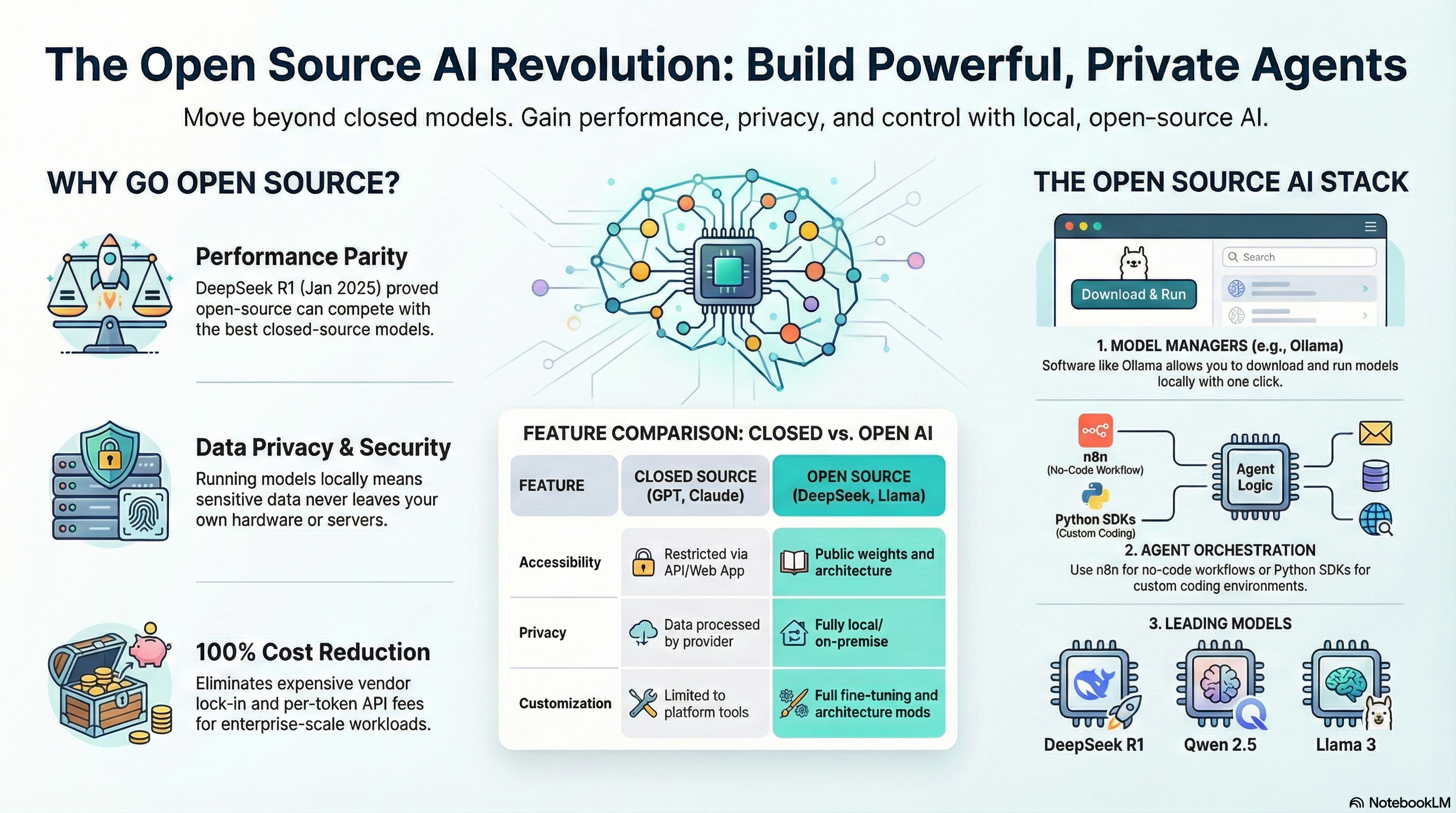
In this post, I want to share a comprehensive overview of the current open-source AI landscape, highlighting how community-driven innovation is reshaping the industry.
The Convergence of Performance
For years, proprietary models like GPT-4 and Gemini held the crown for raw reasoning and coding capabilities. However, 2025 and 2026 have been watershed years for open weights. We are now seeing models that run locally on consumer hardware challenging the very best cloud-based APIs.
Key Players in 2026
- Llama 4 (Meta): The benchmark for open-source. With its new Mixture-of-Experts (MoE) architecture, Llama 4 models (Scout, Maverick, and the massive Behemoth) are delivering multimodal capabilities that rival GPT-4o and Gemini 2.0 Pro.
- DeepSeek: The disruptor. DeepSeek’s “R1” series has democratized advanced reasoning. By proving that frontier-level math and logic skills don’t require billion-dollar training runs, they have fundamentally changed the economics of AI.
- Mistral: The efficiency kings. Continuing their legacy, Mistral’s latest models offer incredible performance-per-watt, making them the go-to for enterprise deployments where cost and latency matter.
Why Open Source Wins
The visual above (OpenSources.png) captures the vibrancy of this ecosystem. But why are companies and researchers flocking to these models?
- Data Sovereignty: You can’t leak secrets to a cloud API if you never send the data. Open models allow for fully air-gapped, on-premise capability.
- Customization: Fine-tuning a 70B parameter model on your specific domain data often yields better results than zero-shot prompting a larger generalist model.
- Cost: The inference cost collapse is real. Self-hosting open models can be 10-50x cheaper than API calls for high-volume workloads.
The Future is Open
The open-source AI community has proven that innovation isn’t a monopoly. With tools like Qwen3, GLM-5, and the ever-evolving Llama ecosystem, the future of AI is collaborative, transparent, and incredibly powerful.